

Summary: Dries’ DrupalSouth 2024 presentation highlighted Drupal’s evolution, from its beginning as a personal project in 2001 to Drupal’s strategic direction in the coming years. He emphasised the strong foundation and the need to drive innovation (to keep Drupal’s appeal) and marketing (to spread the word).

- Date:
- Author:
- Phillipa Martin
The presentation
Below is our summary of Dries’ presentation.
Drupal’s past
Dries started Drupal when he was about 20 years old and studying at university. He built the system for himself and then open sourced it.
One key turning point early on was in 2002, when Dries reached out to Jeremy Andrews, the person behind KernelTrap, a kernel development blog. At the time, many websites fell victim to something called the Slashdot effect. Slashdot was so popular at the time that if your site was mentioned on Slashdot you’d get a massive spike of traffic and websites would often crash. Dries wrote to Jeremy and said that if he migrated his site Drupal it would never crash. He even offered Jeremy root access via email.
Jeremy did end up migrating his site from PHPNuke to Drupal and…it crashed the next time it was mentioned on Slashdot. Together, Dries and Jeremy worked on Drupal making performance improvements. One of the fixes, the Throttle module, is still part of core. It disables elements when traffic spikes to deal with the extra load.
Drupal was withstanding the Slashdot effect and people started writing articles about it.
Dries summed up that story by commenting on how it shows the power of one email. It also made him focus on honouring the contributors.
In 2005, they ran the first DrupalCon in Antwerp. Thirty Drupal developers came to the conference and, while small, it was a success and they decided to keep organising DrupalCons.
In 2007, they started the Drupal Association — Dries joked that it was largely because he needed a cheque account for events! The Drupal Association allowed them to scale events.
At this stage, Drupal was growing but Dries was still doing it as a hobby, mostly in the evenings. Then, MTV moved to Drupal. Dries was keen to help such a large, prominent client, knowing if they weren’t successful it would hurt Drupal’s reputation and brand.
Dries then co-founded Acquia because he knew to make Drupal successful he needed to:
- Help large websites
- Innovate and improve Drupal software
Acquia was set up as the organisation to deliver these two key elements.
Another big moment for Dries and Drupal was in 2010, during DrupalCon in San Francisco. The event was incredibly well-attended — 3000 people. Dries asked people to stand up if Drupal had changed their lives…and everyone stood up. Dries described it as an amazing moment for him, as:
“Another step in my evolution, and why I do what I do.”
At this stage he also started caring more about the open web — a web for all.
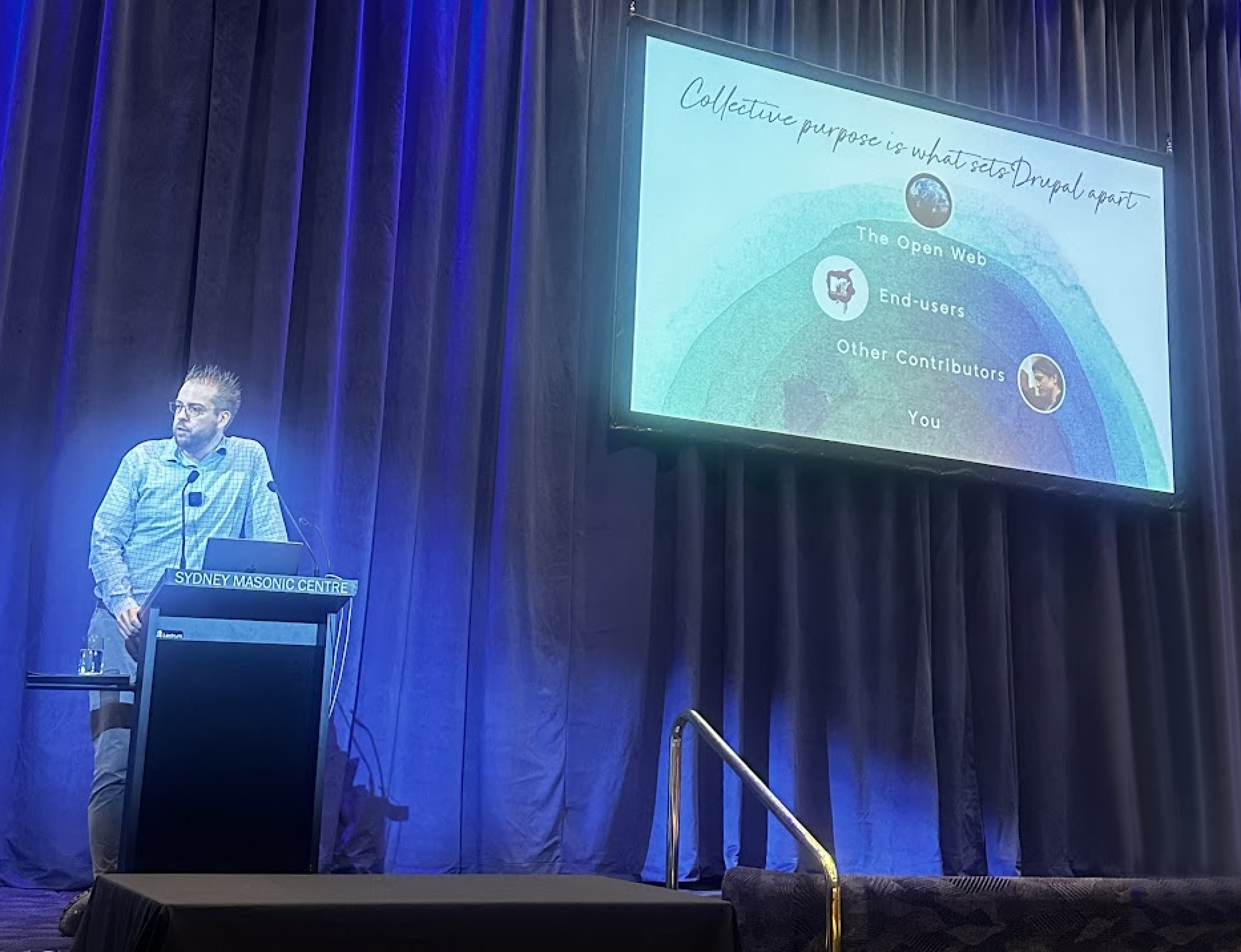
He referred to the image in the slide above as representing his journey, but others’ journeys too.
When you start, it might be about you — getting up to speed, providing income for your family, etc. Then you start caring about others (contributors and end users) and then start caring about the open web.
Drupal’s present
Today, one in eight enterprise websites runs on Drupal, which means that everyone on the web uses Drupal. Dries talked about the many incredible brands now on Drupal and played a video that highlighted some of those brands/logos.
It was great to see the Australian Government feature in the video.
Drupal was also recently named a Digital Public Good by the United Nations.
Another recent development for Dries and Drupal is the Open Web Manifesto. Dries described it as an:
“Important, pivotal moment for me because I’d been championing the open web and advocating for it…everyone, everywhere, should be able to help build an open web.”
Another element of the present is the number of organisations contributing to Drupal. The number of unique contributors is growing too. And in terms of innovation, Dries mentioned AI, talking about the fact that Drupal was one of the first CMSs to have OpenAI integration.
“We beat every other competitor to it.”
Dries showcased the AI integration within Drupal. The Drupal backend can: suggest summaries based on text, do auto tagging, embed features and change a piece of content’s tone of voice (e.g. make it friendlier or more professional).
He summarised Drupal’s current state as “rock solid”.
Next, Dries talked about Drupal’s impact.
“Drupal continues to have an impact on people’s lives.”
To demonstrate this point, Dries showed a video of a woman’s experience upskilling in Drupal and moving from welfare to earning a good income to support herself and her children.
“These stories are why I’m still here after 23 years.”
Drupal’s future
Working on Drupal’s strategic direction, two key action points have been identified:
- Drive innovation
- Drive marketing
Innovation will ensure the product is strong and competitive, and marketing will ensure people know about Drupal and all of its features.
To do this, the Drupal Association is focusing on growing contributions and targeting ‘ambitious site builders’.
To grow contributors, Drupal is:
-
Improving contribution tools
-
Focusing on contributor onboarding
-
Simplifying the core development process
-
Expanding philanthropy to grow donations
-
Changing the Certified Partner Program to reward organisations that contribute
In terms of marketing, a recent activity Dries mentioned was attending and exhibiting at Web Summit, the largest web development conference in the world.
Drupal is also driving innovation. Key initiatives for innovation include:
-
Pitch-burgh (an innovation contest)
-
Automatic updates (this is the number 1 feature people want)
-
Project Browser so people don’t need to go into the command line to install Drupal modules
-
Recipes so people can install common bundles of modules and configuration settings to create higher level building blocks
-
Next Generation Page Builder, which was announced at DrupalCon Europe 2023 in Lille
Dries’ closing
Dries closed his keynote by talking about what people in the audience could do — from running local community events and code sprints to becoming a Certified Partner.
“Let’s scale our impact, together.”